Professional Fertilizer Equipment, Straw Processing Equipment, Waste Processing Equipment and Mining Equipment Manufacturer.
Contact Info
Apartemen Neo Soho Lantai 10 Unit 10, Jl. Letjan S parman kav.28, Kel. Tanjung Duren Selatan Kec.
Professional Fertilizer Equipment, Straw Processing Equipment, Waste Processing Equipment and Mining Equipment Manufacturer.
Apartemen Neo Soho Lantai 10 Unit 10, Jl. Letjan S parman kav.28, Kel. Tanjung Duren Selatan Kec.
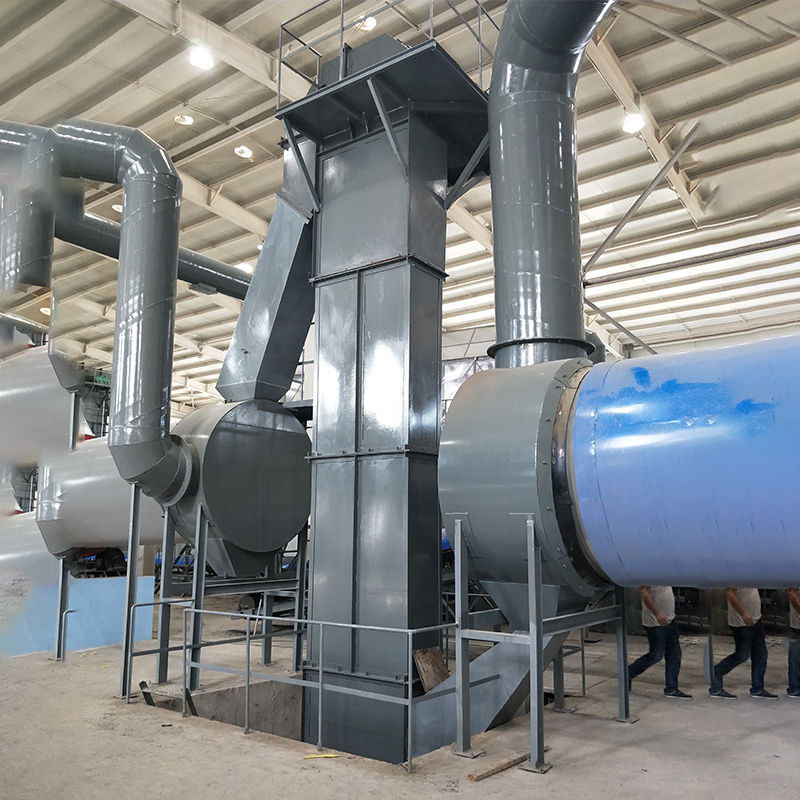
A bucket elevator is a device that continuously transports bulk materials vertically or at a large inclination angle. Its core consists of a traction component (chain/tape), a hopper, a machine head, a barrel, and a machine base. It has the advantages of small footprint, high head, and environmentally friendly sealing, and is widely used in industries such as grain, mining, building materials, and chemical engineering.
Material retrieval: The material flows into the bottom feeding port and is scooped up by the hopper.
Enhancement: The motor and reducer drive the head wheel, which drives the traction component (chain/tape) to circulate and lift the hopper vertically.
Unloading: After the hopper reaches the head, it flips and unloads according to centrifugal/gravity/mixed methods, and the material is discharged from the discharge port.
Return journey: The empty hopper descends and returns to the bottom, repeating the operation.
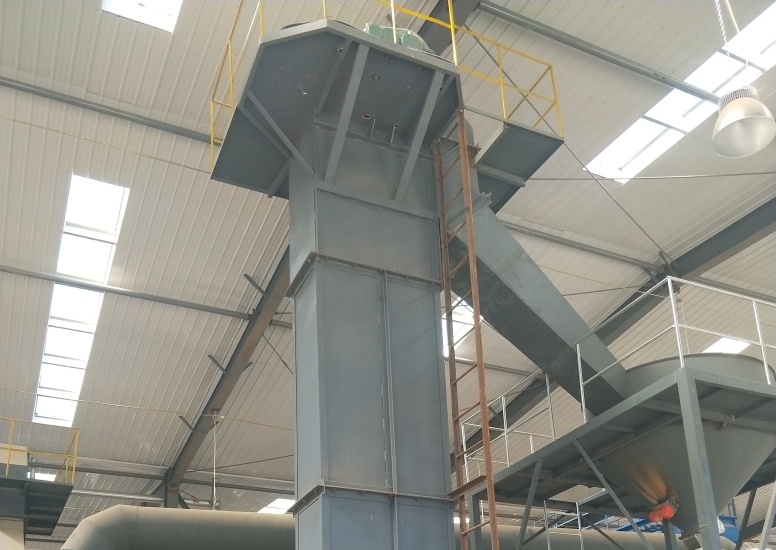
1. Head (head)
Composition: Drive device (motor, reducer, backstop), head wheel (sprocket/drum), discharge port, maintenance platform.
Function: Provide power, control unloading, and prevent reversal.
2. Traction components
Loop chain (TH type): Low cost, suitable for medium loads, universal scenario.
Plate chain (NE type): high strength, wear-resistant, suitable for large/heavy materials.
Tape (TD type): High speed, low noise, suitable for lightweight/powdery materials, temperature ≤ 60 ℃ (heat-resistant tape ≤ 150 ℃).
3. Hopper
Deep bucket (Z-type): The bucket is deep and suitable for flowable powder/granular materials (such as grains and coal powder).
Shallow bucket (Q-type): The bucket has a shallow depth and is suitable for materials that are prone to clumping/wetting, such as clay and wet sand.
Scale bucket (pointed bottom bucket): suitable for large pieces/materials with strong grinding properties (such as ore and crushed stone).
Material: Carbon steel, stainless steel (food/chemical), wear-resistant steel (high wear).
4. Barrel (middle box)
Segmented enclosed structure, dust-proof and anti scattering materials, ensuring safe operation.
5. Machine base (tail)
Composition: feed inlet, bottom wheel (tensioning wheel), tensioning device (screw/heavy hammer).
Function: Adjust the tension of the traction components to ensure smooth operation.
Main classification of bucket elevator
1. According to the traction component
TD type (tape): High speed, low noise, lightweight/powdery material.
TH type (ring chain): universal, economical, medium load.
NE type (plate chain): heavy-duty, wear-resistant, large/heavy materials.
2. According to the unloading method
Centrifugal: High speed (1.2-2.0m/s), suitable for powder/fine particles.
Gravity type: low speed (0.4-0.8m/s), suitable for large/abrasive materials.
Hybrid: Medium speed, strong versatility.
3. According to the installation form
Vertical: 90 ° installation, minimal footprint, most commonly used.
Tilt type: Tilt angle<75 °, requires guidance, suitable for special layouts.
Conveying capacity: 10-1000m ³/h.
Lifting height: ≤ 40m (special up to 80m).
Material particle size: ≤ 200mm (according to hopper specifications).
Material temperature: Normal ≤ 60 ℃, heat-resistant ≤ 150 ℃.
Advantages and disadvantages of bucket elevator
advantage
Small footprint: Small horizontal size, vertically arranged to save space.
High lift: can achieve vertical lifting of over 40m.
Sealed and environmentally friendly: Fully enclosed body, minimal dust and pollution.
Stable operation: simple structure, high reliability, and long fault free time.
shortcoming
Sensitive to overload: requires uniform feeding, prone to material blockage.
The hopper/traction parts are vulnerable: worn parts need to be replaced regularly.
Not suitable for conveying viscous materials: easy to stick to buckets, difficult to unload.
Grain industry: Improvement of granular materials such as wheat, corn, and soybeans.
Mining/Metallurgy: Bulk/powdery materials such as ore, coal powder, coke powder, etc.
Building materials industry: powder/granular materials such as cement, lime, sand and gravel.
Chemical industry: granular/powdered materials such as fertilizers, soda ash, resins, etc.
Food industry: flour, starch, nuts, etc., with stainless steel hopper.
Material characteristics: particle size, flowability, humidity, temperature, grindability.
Conveying capacity: Calculate the hourly conveying capacity and select the corresponding specifications.
Raise height: Determine the center distance between the head and tail wheels, and choose the number of cylinder sections.
Traction component types: lightweight adhesive tape, universal ring chain, heavy-duty plate chain.
Unloading method: centrifugal for powder/fine particles and gravity for large blocks.
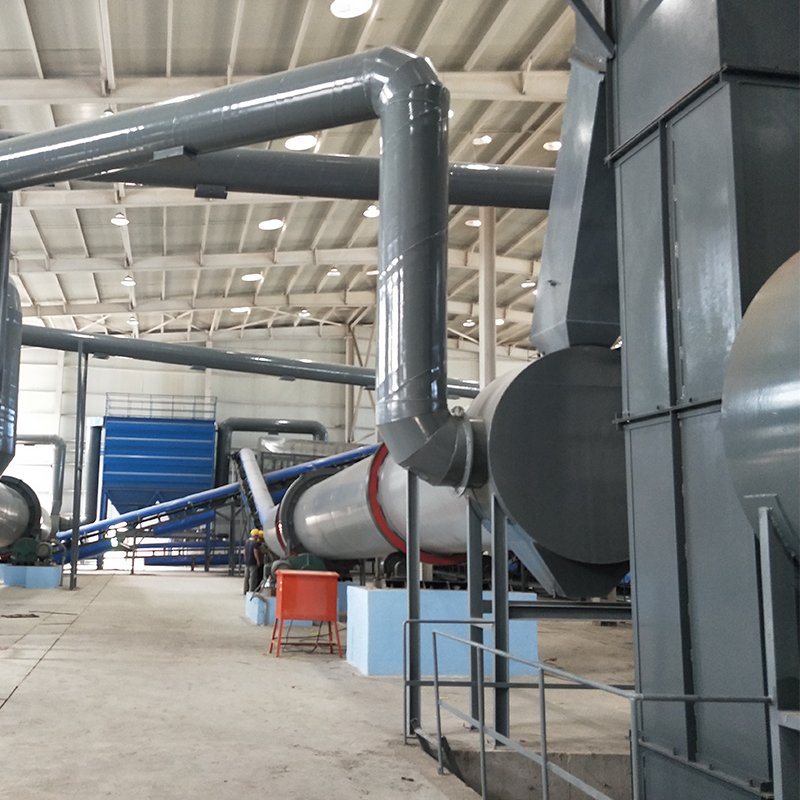
Install
Vertical correction: The verticality of the entire machine is ≤ 1/1000.
Tension adjustment: The tension of the traction component is moderate and there is no deviation.
Sealing treatment: The cylinder flange and maintenance door are well sealed to prevent dust leakage.
maintain
Daily inspection: hopper bolts, chain/tape tension, wear condition.
Regular lubrication: Head wheel, tail wheel bearings, gearbox oil change.
Replacement of vulnerable parts: If the wear of the hopper, chain, and lining exceeds the standard, replace them in a timely manner.
Safety protection: Regular calibration of chain/belt breakage protection, backstop, and overload protection devices.
Blockage: The reason is that the material is added too quickly and has high viscosity; Exclusion: Reduce the amount of material added and clean the sticky material in the hopper.
Deviation: The reason is uneven tension and improper installation; Exclusion: Adjust the tensioning device and correct the verticality.
Hopper detachment: The reason is that the bolts are loose and severely worn; Exclusion: Tighten bolts and replace hopper.
 WhatsApp
 Email
Email
 + 8613905485429