Professional Fertilizer Equipment, Straw Processing Equipment, Waste Processing Equipment and Mining Equipment Manufacturer.
Contact Info
Apartemen Neo Soho Lantai 10 Unit 10, Jl. Letjan S parman kav.28, Kel. Tanjung Duren Selatan Kec.
Professional Fertilizer Equipment, Straw Processing Equipment, Waste Processing Equipment and Mining Equipment Manufacturer.
Apartemen Neo Soho Lantai 10 Unit 10, Jl. Letjan S parman kav.28, Kel. Tanjung Duren Selatan Kec.
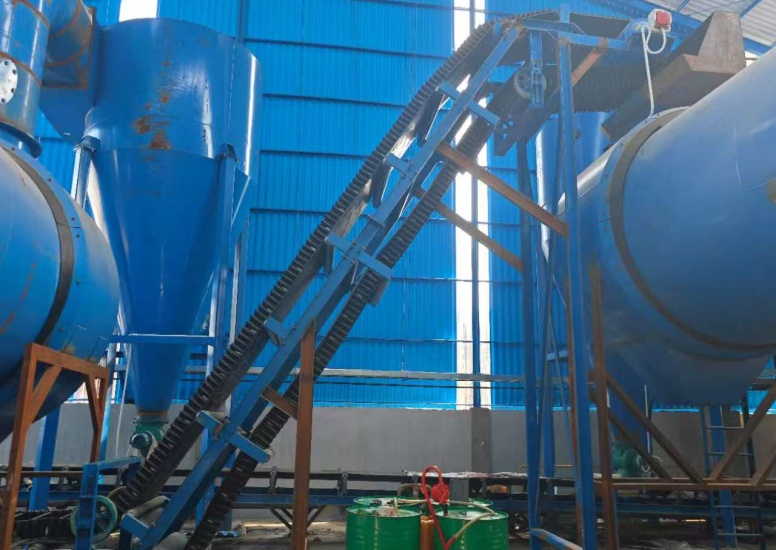
The core feature of the inclined conveyor is the ability to transport materials along an inclined angle, balancing space saving and continuous conveying efficiency, and adapting to the needs of material transportation in multiple scenarios.
Core Features
High space utilization: By using a tilted layout instead of a combination of horizontal and vertical conveying, the flat space occupied by equipment is greatly reduced, especially suitable for limited scenarios such as workshops and warehouses.
Flexible conveying direction: The tilt angle can be adjusted according to demand (commonly 0 ° -60 °), enabling material transfer between different heights and connecting equipment for upper and lower processes (such as silos, granulators, coating machines, etc.).
Continuous conveying efficiency is stable: It can achieve uninterrupted continuous conveying, with conveying volumes ranging from a few cubic meters to hundreds of cubic meters per hour, suitable for different needs from small-scale production to large-scale assembly lines.
Wide material adaptability: For granular materials, powders, and block materials (such as organic fertilizer particles, ores, grains, etc.), different conveyor belts (such as anti-skid belts, corrugated edge belts) or conveyor structures (spiral, belt) can be selected for adaptation. Some models can also handle materials with high humidity.
Energy consumption and cost balance: Compared to vertical elevators, it has a simpler structure and lower maintenance costs; Compared to horizontal conveyors, it shortens the conveying path, saves energy, and has outstanding cost-effectiveness.
Equipped with anti instability design: Material sliding is prone to occur during inclined conveying, so the equipment is often equipped with anti slip conveyor belts, side rails, adjustable tilt angle mechanisms, etc., to ensure stability during material conveying.
The core application scenario of inclined conveyor is continuous material transfer between different heights, especially suitable for scenarios with limited space and the need to connect multiple processes, covering multiple fields such as agriculture, industry, logistics, etc.
Main application scenarios
In the field of agriculture and fertilizer production: This is the core application of organic fertilizer related scenarios that you are concerned about. It can connect various links of the organic fertilizer production line, such as tilting the raw materials in the silo to the granulator, transporting the granulated particles to the coating machine, or transporting the finished fertilizer from a low position to a high position silo and packaging equipment, adapting to the transportation of organic fertilizer materials such as granular materials and powders.
Mining and building materials industry: used for conveying block or granular materials such as ore, sand and gravel, cement clinker, etc., such as from low material piles in mining sites, inclined conveying to crushers and screening machines, or transferring from low-level equipment in workshops to high-level material bins, with a common inclination angle of 30 ° -45 °, equipped with anti-skid conveyor belts to avoid material rolling off.
Manufacturing workshop: adapted to the material connection between online and offline production processes, such as conveying powdered raw materials in the chemical industry, transporting parts in the mechanical industry, and conveying processed food ingredients (such as grains, fruits and vegetables) in the food industry. By tilting the layout, the workshop saves floor space and makes the assembly line layout more compact.
Logistics and warehousing industry: used for cargo loading and unloading and warehouse sorting, such as tilting the goods (such as cardboard boxes, packages, bagged materials) in the truck carriage to the high-level shelves of the warehouse, or transporting them from the sorting line to the high-level packaging platform, to improve loading and unloading and sorting efficiency.
Grain and Feed Industry: Transporting materials such as wheat, corn, and feed pellets, such as tilting from the bottom of the grain silo to the elevator, and from the outlet of the mixer to the finished product silo. It can be equipped with a sealed structure to prevent material dust and protect material quality.
In the field of construction waste disposal: transporting demolition waste, concrete fragments and other materials, connecting crushing and screening equipment to achieve continuous transportation between different heights, and assisting in the efficient operation of construction waste resource utilization production lines.
Jinhua Machinery Provides High Quality And Effective Fertilizer Manufacturing Equipment, Straw Processing Equipment, Waste Processing Equipment, And Mining Equipment.If you are looking for fertilizer-making machines and production lines, feel free to contact us.Tel:0811-8185429 011-820-8086 E-mail:jinhuaindonesia@gmail.com
 WhatsApp
 Email
Email
 + 8613905485429