What is a Powder Fertilizer Production Line?
2025-12-02 14:14:03
By : root
A
powder fertilizer production line refers to a set of
continuous and automated equipment combinations designed to process various raw materials (organic, inorganic, or composite) into uniform, dry, and agriculturally acceptable powdered fertilizers through a series of processes such as pretreatment, crushing, mixing, sieving, metering, and packaging. The end products can be directly applied in farmlands, fruit and vegetable plantations, gardens, and other scenarios, or serve as intermediate materials for granular fertilizer production.
Powder Fertilizer Production Line Core Composition and Process Flow
1. Core Equipment Composition
|
Process Stage
|
Key Equipment
|
Function
|
|
Raw Material Pretreatment
|
Raw material silos, conveyors, impurity removers (sieving/magnetic separation)
|
Store raw materials, transport and feed materials, and remove impurities such as stones and metals
|
|
Crushing Process
|
Hammer crushers, vertical crushers, ultra-fine crushers
|
Crush bulk raw materials (e.g., straw, ore, cake meals) to a fineness of 80-120 meshes
|
|
Mixing Process
|
Twin-screw mixers, gravity-free mixers
|
Uniformly mix multiple raw materials (e.g., nitrogen-phosphorus-potassium single fertilizers, trace elements, organic matter) to ensure nutrient uniformity
|
|
Drying and Cooling (Optional)
|
Drum dryers, airflow dryers, coolers
|
Remove moisture from raw materials (moisture content ≤10%) to prevent caking and improve storage stability
|
|
Sieving and Classification
|
Vibrating sieves, classifying sieves
|
Screen out unqualified coarse particles and return them to the crushing process to ensure uniform fineness of finished products
|
|
Metering and Packaging
|
Automatic weighing scales, sewing machines, palletizers
|
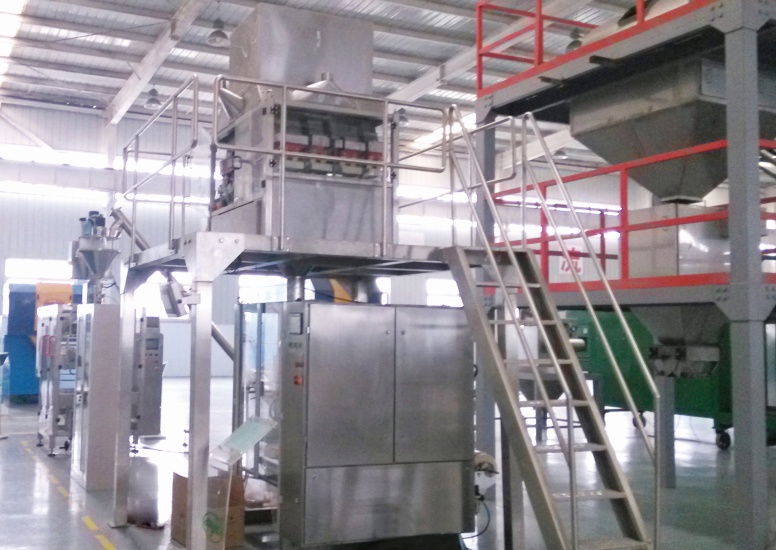
Quantitative weighing (25kg/50kg/ton bags), sealed packaging, and automated palletizing
|
2. Typical Process Flow
Raw Materials → Impurity Removal & Pretreatment → Crushing → (Drying & Cooling) → Mixing (Adding Trace Elements/Additives) → Sieving → Metering & Packaging → Finished Product Storage Note: Organic raw materials require an additional “fermentation and decomposition” pretreatment process, while inorganic raw materials can be directly crushed and mixed.
Powder Fertilizer Production Line Scope of Application
1. Types of Raw Materials
-
Inorganic raw materials: Urea, diammonium phosphate, potassium chloride, potassium sulfate, bentonite, and other single fertilizers or mineral raw materials;
-
Organic raw materials: Decomposed livestock and poultry manure, straw, cake meals (soybean cake, cottonseed cake), humic acid, amino acid residue, etc.;
-
Composite raw materials: Organic-inorganic composite raw materials, mixed raw materials of biological agents and inorganic fertilizers, compound raw materials of trace elements (iron/zinc/boron).
2. Application Scenarios
-
Agricultural production: Base fertilizer/topdressing for field crops (wheat, corn, rice), cash crops (vegetables, fruits, flowers), and Chinese medicinal materials planting;
-
Fertilizer processing enterprises: Finished product production or intermediate product processing for small and medium-sized organic fertilizer factories, inorganic fertilizer factories, and compound fertilizer factories;
-
Customized production: Adjust formulas according to crop needs (e.g., high-nitrogen type, high-potassium type, trace element type) to produce special-purpose powdered fertilizers.
Powder Fertilizer Production Line Key Advantages and Disadvantages
1. Advantages
-
Simple and efficient process: Short process flow, low equipment investment cost, and fast commissioning cycle (3-6 months to put into operation);
-
Good nutrient uniformity: High mixing precision (uniformity error ≤3%), no “nutrient stratification” problem of granular fertilizers;
-
Wide range of applicable raw materials: Compatible with organic, inorganic, and composite raw materials, with flexible formula adjustment;
-
Convenient application: Powdered form is easy to dissolve (water-soluble powdered fertilizers) or broadcast, suitable for mechanized fertilization (e.g., UAV broadcasting, fertilizer spreaders);
-
Significant cost advantage: No granulation process required, low energy consumption (30%-50% more energy-efficient than granular production lines), and lower transportation costs than liquid fertilizers.
2. Disadvantages
-
Easy to absorb moisture and cake: The powdered form has a large specific surface area and is prone to moisture absorption in high-humidity environments, requiring the addition of anti-caking agents or moisture-proof packaging;
-
Dust problem: Dust is easily generated during production, requiring supporting dust removal equipment (e.g., pulse dust collectors) to meet environmental protection requirements;
-
Transportation efficiency: The weight per unit volume is lower than that of granular fertilizers, so the long-distance transportation cost is slightly higher than that of granular fertilizers (little impact on short-distance transportation).
Powder Fertilizer Production Line Key Technical Parameters (Reference Range)
|
Parameter Type
|
General Indicators
|
Customization Range
|
|
Production Capacity
|
5-20 tons/hour
|
0.5-50 tons/hour (small laboratory → large-scale industrialization)
|
|
Finished Product Fineness
|
80-120 meshes (adjustable via screen)
|
60-200 meshes (ordinary fertilizer → fine fertilizer)
|
|
Mixing Uniformity
|
≥97%
|
≥98% (high-end customized lines)
|
|
Moisture Content
|
≤8%-10% (finished product standard)
|
≤5% (low-humidity storage requirements)
|
|
Power Consumption
|
15-50kW (5 tons/hour capacity)
|
5-200kW (capacity-matched on demand)
|
|
Automation Level
|
Semi-automatic/full-automatic
|
PLC control system can be configured to realize unmanned operation
|
Powder Fertilizer Production Line Application Value and Market Positioning
With “low cost, high flexibility, and easy operation” as its core advantages, the powder fertilizer production line is suitable for investment and construction by small and medium-sized fertilizer enterprises, agricultural cooperatives, and large-scale planting bases. It can quickly respond to market demands for special-purpose fertilizers, organic fertilizers, and composite powdered fertilizers. Especially in the fields of fruit and vegetable planting, protected agriculture, and ecological agriculture, powdered fertilizers are favored due to their fast effect and easy formula adjustment. At the same time, as a pre-processing link of granular fertilizer production lines, it is also widely used in the industrial chain layout of large-scale fertilizer production enterprises.
Suppliers of Powder Fertilizer Production Line:
Jinhua Machinery Provides High Quality And Effective Fertilizer Manufacturing Equipment, Straw Processing Equipment, Waste Processing Equipment, And Mining Equipment.If you are looking for fertilizer-making machines and production lines, feel free to contact us.Tel:0811-8185429 011-820-8086 E-mail:
jinhuaindonesia@gmail.com
 WhatsApp
 Email
Email
 + 8613905485429