what is a Twin Shaft Mixer?
2025-11-12 13:29:40
By : root
A
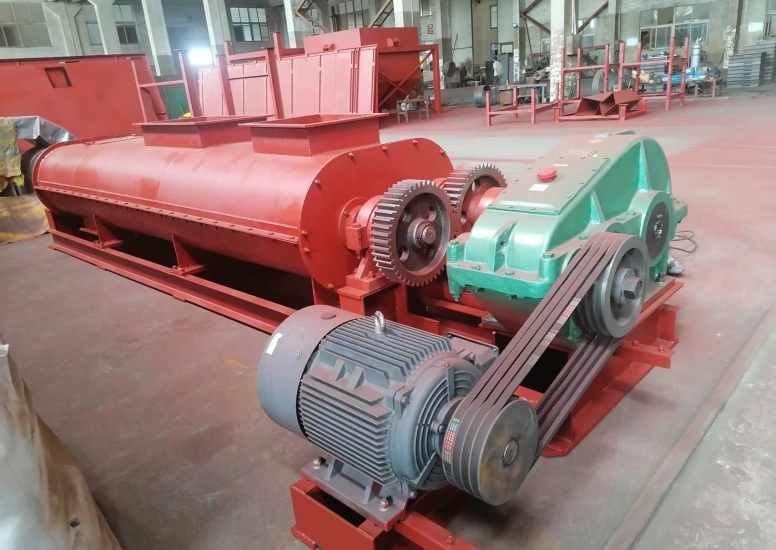
twin shaft mixer (also called a double shaft mixer) is a high-efficiency mixing device equipped with two parallel, counter-rotating shafts fitted with paddles or blades. It is widely used in industrial production to blend powdery, granular, or paste-like materials, and is characterized by strong mixing intensity, uniform mixing results, and high processing efficiency.
The twin shaft mixer operates based on the synergy of counter-rotating shafts and specially designed paddles:
- Two parallel shafts rotate in opposite directions (usually at a speed of 30–60 rpm, adjustable according to production needs).
- Each shaft is equipped with multiple sets of paddles (or spiral blades) with specific angles and shapes. As the shafts rotate, the paddles lift, push, and shear the materials.
- Materials are subjected to three key actions simultaneously:
- Radial circulation: Paddles on opposite shafts push materials toward each other, creating cross-mixing.
- Axial movement: Angled paddles drive materials to move along the shaft (forward/backward), ensuring full blending of materials throughout the entire tank.
- Shearing and kneading: High-speed relative motion between paddles breaks up agglomerated materials and improves the uniformity of component distribution.
A standard twin shaft mixer consists of the following core parts, each with a specific function:
Due to its strong mixing capacity and adaptability to various materials, the twin shaft mixer is widely used in multiple industries:
- Construction Materials: Mixing concrete, dry-mixed mortar, cementitious materials, and lightweight aggregates (high mixing uniformity ensures stable product strength).
- Chemical Industry: Blending powdery chemicals (e.g., fertilizers, pesticides), rubber additives, and resin-based composites (prevents component segregation).
- Food & Pharmaceutical: Mixing food additives, grain powders, or pharmaceutical excipients (models with stainless steel tanks meet hygiene standards such as FDA or GMP).
- Environmental Protection: Treating solid waste (e.g., sludge, fly ash from waste incineration) by mixing with stabilizers or desiccants.
- Metallurgy & Mining: Preparing mineral powders, metal additives, or refractory materials (resistant to wear from hard particles).
- High Mixing Uniformity: The counter-rotating shafts and multi-directional material movement ensure the coefficient of variation (CV) of material blending is usually less than 5% (far lower than that of single-shaft mixers).
- Strong Adaptability: Suitable for materials with high viscosity, large particle size differences, or high moisture content (e.g., wet sludge, viscous pastes).
- Efficient Mixing: Short mixing time (usually 30–120 seconds per batch) and high production capacity, suitable for large-scale continuous production.
- Low Material Residue: The U-shaped tank and optimized paddle design minimize material accumulation in dead corners, reducing waste.
- Higher Equipment Cost: The complex structure (dual shafts, precision drive system) leads to higher manufacturing and purchase costs compared to single-shaft mixers.
- Larger Space Requirement: The equipment has a larger overall size (especially length) and requires more installation space.
- Higher Maintenance Demand: More moving parts (e.g., two shafts, multiple seals) mean more frequent maintenance (e.g., replacing worn paddles, maintaining seals) and higher maintenance costs.
- Not Ideal for Ultra-Fine Powders: For ultra-fine powders prone to flying, additional dust collection systems are required, increasing overall investment.
Suppliers of Twin Shaft Mixer:
Jinhua Machinery Provides High Quality And Effective Fertilizer Manufacturing Equipment, Straw Processing Equipment, Waste Processing Equipment, And Mining Equipment.If you are looking for fertilizer-making machines and production lines, feel free to contact us.Tel:0811-8185429 011-820-8086 E-mail:jinhuaindonesia@gmail.com
 WhatsApp
 Email
Email
 + 8613905485429