Professional Fertilizer Equipment, Straw Processing Equipment, Waste Processing Equipment and Mining Equipment Manufacturer.
Contact Info
Apartemen Neo Soho Lantai 10 Unit 10, Jl. Letjan S parman kav.28, Kel. Tanjung Duren Selatan Kec.
Professional Fertilizer Equipment, Straw Processing Equipment, Waste Processing Equipment and Mining Equipment Manufacturer.
Apartemen Neo Soho Lantai 10 Unit 10, Jl. Letjan S parman kav.28, Kel. Tanjung Duren Selatan Kec.
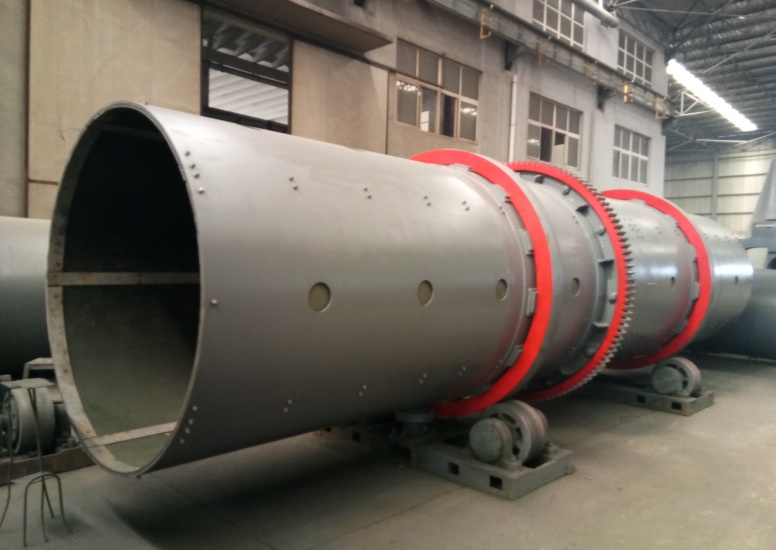
Rotary drum granulator(also known as drum granulator) is a wet agglomeration continuous granulation equipment, which is mainly used to make powder materials into 2-8mm spherical particles. It is widely used in industries such as organic fertilizer, compound fertilizer, feed, chemical industry, building materials, etc. It is suitable for large-scale, low-cost, and high particle roundness production lines.
Tilt the cylinder at 2 ° -5 ° and rotate at a low speed of 10-25r/min; The inner wall copying board continuously picks up and spills materials, forming a rolling bed.
At the feeding end, atomized spray water/steam/binder (starch, bentonite, slurry, etc.) is sprayed, and the powder collides, adheres, and grows layer by layer during rolling, gradually forming balls.
The material stays in the cylinder for 5-10 minutes, and qualified particles overflow from the low-level discharge end; Returned materials (broken particles/fine powder) can be recycled by reflux, with a ball formation rate of 70% -90%.
Can pass steam/hot air (80-120 ℃), combining granulation+preheating/drying, improving strength and drying efficiency.
Drum body: carbon steel lined with rubber/stainless steel (anti sticking, wear-resistant, corrosion-resistant); Internal wall welding spiral/straight plate; Set up material blocking rings at both ends to control the thickness and residence time of the material layer.
Transmission system: motor → reducer → large gear ring+small gear → cylinder body; Variable frequency speed regulation, suitable for different materials/particle sizes.
Supporting wheels and blocking wheels: 4 supporting wheels support the cylinder body; Two gear wheels prevent axial movement and operate stably.
Spray system: high-pressure atomizing nozzle at the feeding end, uniformly spraying adhesive/steam; Adjustable traffic.
Inlet/outlet cover: sealed and dust-proof; Feed can be pre mixed and humidified with a conditioner; Classification of discharge and screening machine.
advantage
Large production capacity: 5-30 tons per hour, with large-scale production lines capable of up to 50 tons per hour, suitable for large-scale production.
Good particle quality: high roundness, high strength, good flowability, adjustable particle size of 2-5mm, deviation ≤ 5%.
Strong adaptability: can handle organic fertilizers, compound fertilizers, chemical powders, feed, etc; Suitable for cold/hot granulation, high/medium/low concentration fertilizers.
Stable operation, low cost: simple structure, long service life of wear-resistant lining plate; Low energy consumption and easy maintenance.
Continuous production: It can operate 24 hours a day and is equipped with full automation for drying, cooling, screening, and coating.
shortcoming
Adhesive/moisture is required, and it must be dried afterwards;
There is return material (10% -30%) that needs to be refluxed for treatment;
Not suitable for high hardness, high fiber, and strongly viscous materials (prone to wall sticking/poor ball formation).
Fertilizer industry (mainstream)
Compound fertilizer: granulation of nitrogen, phosphorus, and potassium raw materials, hot granulation+steam, high balling rate and good strength.
Organic fertilizer/organic-inorganic compound fertilizer: Livestock manure, straw, sludge, etc. are decomposed and granulated to increase added value and facilitate application.
Biological fertilizer/bacterial fertilizer: low-temperature granulation, protecting live bacteria, uniform particles, and no clumping.
other industries
Feed: Granulation of fish meal, soybean meal, etc. to improve palatability and reduce waste.
Chemical industry: pigments, dyes, catalysts, inorganic salt granulation.
Building materials/environmental protection: Fly ash, lime, and sludge are used to make granules, which are easy to transport and utilize.
Cylinder diameter 1.5-2.5m
Cylinder length 4-8m
Length to diameter ratio of 3-5:1
Rotational speed 15-20r/min (variable frequency adjustable)
Installation angle 3 ° -5 °
Working temperature: normal temperature -120 ℃
Ball formation rate ≥ 80%
Particle size 2-5mm (adjustable)
Hourly output of 10-20 tons
Power 30-75kW
VS disc granulator: Large drum production capacity, more round particles, suitable for large-scale production; Disk investment is low, operation is simple, and suitable for small batches.
VS roller extrusion granulator: The drum particles are round, have good strength, and can be used as slow-release fertilizer; Squeezing does not require moisture/drying, has low energy consumption, and is suitable for dry powder, but the particles are irregular and have low strength.
Key points for selecting rotary drum granulator
Raw material characteristics: moisture, viscosity, fiber content, corrosiveness; High viscosity rubber lining board+anti sticking sheet.
Capacity demand: small (hourly production<5 tons), medium (5-20 tons), large (>20 tons).
Particle requirements: particle size, strength, roundness, uniformity.
Supporting process: Whether steam heating, hot air drying, cooling, screening, and coating are required.
 WhatsApp
 Email
Email
 + 8613905485429